
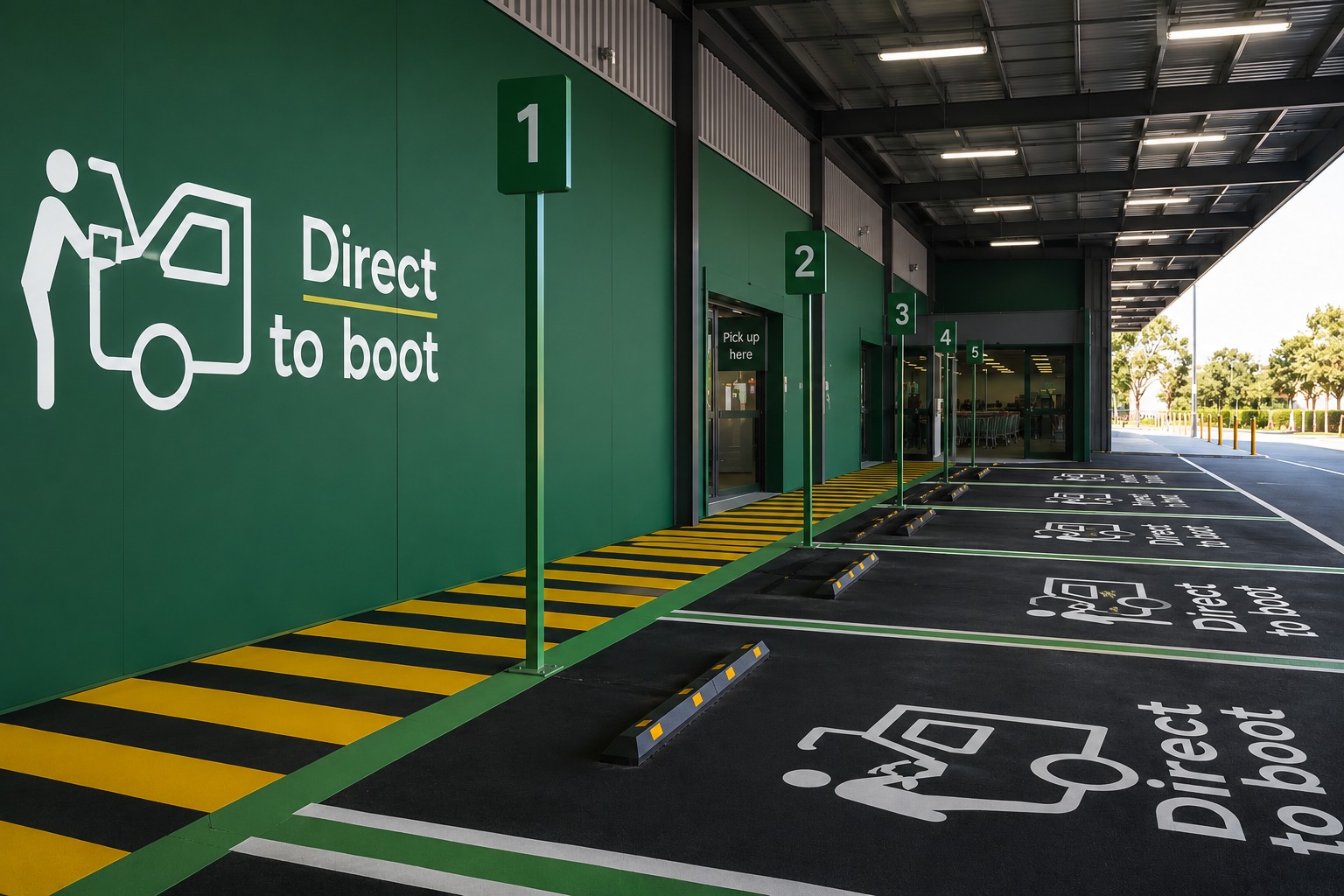
Woolworths DTB Optimisation
Client
Project Size
Value
As Woolworths move into the optimisation phase of its Direct to Boot (DTB) network, the focus shifts from rapid expansion to refining a high-volume, nationally consistent service model. What began as a convenience offering during the pandemic has matured into a core retail channel, fundamentally changing how customers interact with supermarket environments. This next phase of rollout required more than operational efficiency. It demanded a coordinated approach to compliance across hundreds of sites, spanning multiple jurisdictions with increasingly divergent regulatory frameworks. MBC Group was engaged to support this transition, developing a national compliance approach to guide delivery teams, designers and approval authorities through a complex and evolving landscape.
DTB presents a deceptively simple customer experience; order online, drive in, and have groceries loaded into your vehicle. Behind this simplicity sits a hybrid use that does not fit neatly within traditional building classifications. Depending on its configuration, a DTB facility can sit somewhere between a retail space, a warehouse function and a car park. This ambiguity could lead to inconsistent interpretations across jurisdictions, particularly when applied to existing stores being retrofitted for high-turnover pickup operations.
At the same time, the regulatory environment itself is shifting. The staged adoption of NCC 2025 across different states introduces a layer of uncertainty, with projects often needing to navigate overlapping compliance regimes. What was acceptable under one version of the Code in one state could trigger redesign in another. This was particularly pronounced in areas such as accessibility, egress, and the treatment of external loading zones. Compounding this was the pace and scale of rollout. Woolworths was not delivering a single bespoke facility, but a repeatable national model. Without a structured framework, each project risked becoming a one-off exercise in interpretation, slowing approvals and increasing delivery risk.
MBC Group responded by developing a comprehensive DTB compliance workbook, designed to bring clarity and consistency to a rapidly evolving model. Rather than treating each site in isolation, the workbook established a national logic for how DTB environments should be classified, assessed and delivered. Central to this was a clear articulation of building classification pathways, supported by jurisdiction-specific guidance where interpretation differed. This allowed project teams to move forward with confidence, while still acknowledging local nuances. Similarly, fire safety and egress strategies were rationalised to suit both retrofit and new-build scenarios, ensuring that operational efficiency did not come at the expense of safety outcomes.
The result was a unified framework that allowed Woolworths to deliver its DTB optimisation program with greater certainty and speed. Approval pathways were streamlined, design rework was reduced, and project teams were able to operate with a shared understanding of compliance expectations across the country. Just as importantly, the approach positioned Woolworths to navigate the transition to NCC 2025 with confidence. By embedding future considerations into current design thinking, the risk of disruption during Code adoption was significantly reduced.
Like reading about our projects?
Contact us to discuss your proposed development and find out how we can deliver outstanding results for your development.